
McDonald’s Bets Big on AI: How Artificial Intelligence Is Transforming the Future of Fast Food
Artificial intelligence is no longer just a futuristic concept. It is becoming an essential part of how major companies operate, serve customers, and improve efficiency. One of the world's most recognizable fast-food brands, McDonald's, is taking a major step forward with its new AI-powered restaurant operating platform, ArchIQ.
Announced in September 2026 as part of the company's broader Next strategy, ArchIQ aims to transform everything from drive-thru ordering and inventory management to food preparation and order accuracy.
But McDonald's latest investment in AI represents something bigger than faster burgers and shorter lines. It offers a glimpse into a future where intelligent technology works alongside employees to create smarter, more efficient businesses.
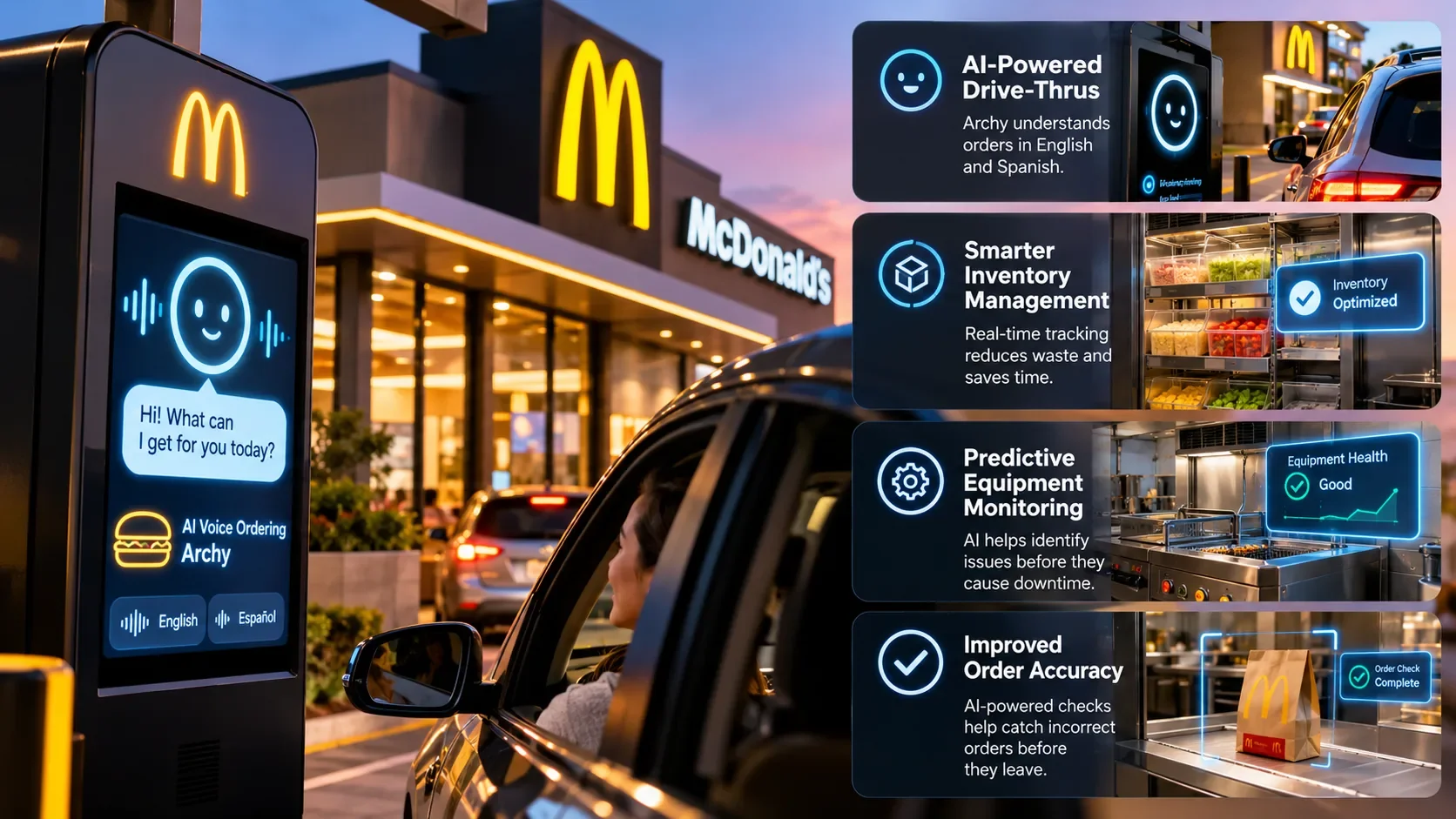
Meet ArchIQ: The AI Brain Behind McDonald's Restaurants
McDonald's is developing ArchIQ as a unified artificial intelligence platform designed to connect and optimize restaurant operations.
Rather than relying on separate technologies for different tasks, ArchIQ brings automation, predictive analytics, equipment monitoring, and operational insights together.
The system builds on years of digital infrastructure development, including McDonald's partnership with Google and the creation of a standardized data platform connecting restaurant operations worldwide.
With more than 46,000 restaurants globally, McDonald's has access to enormous amounts of operational information. This data can help AI systems identify patterns, predict problems, and make faster decisions.
The goal is simple: reduce repetitive work, improve restaurant performance, and give employees more time to focus on customers.
1. AI-Powered Drive-Thrus That Understand Your Order
One of the most exciting features of ArchIQ is Archy, McDonald's AI-powered voice ordering technology.
Instead of speaking directly to an employee at the drive-thru, customers may interact with an intelligent voice assistant capable of understanding their orders.
According to McDonald's executives, Archy can process orders in English and Spanish, with reported accuracy exceeding 90% in early testing.
The company also expects the technology to free up at least 50 labor hours per restaurant each week as it scales.
Imagine pulling into a drive-thru and placing an order while AI processes your selections, sends the information to the kitchen, and helps employees prepare your food.
The potential benefits include faster ordering, more consistent service, and reduced pressure on restaurant employees during busy periods.
However, real-world success will depend on how well these systems handle background noise, unusual requests, changing menus, and customer preferences.
2. Smarter Inventory Management With AI
Managing inventory is one of the most demanding responsibilities in the restaurant business.
Employees must regularly count ingredients, monitor supplies, and determine when products need to be replenished.
ArchIQ introduces automated inventory tracking using Bluetooth Low Energy technology.
McDonald's estimates that the system could save approximately five labor hours per restaurant per week and reduce food waste by 15%.
This represents an important opportunity for restaurant operators.
With better visibility into inventory, businesses can potentially reduce unnecessary purchases, avoid shortages, and improve operational planning.
3. Computer Vision and Predictive Equipment Monitoring
Artificial intelligence is also moving into the kitchen.
McDonald's plans to use connected equipment and computer vision technology to help monitor food quality, equipment performance, and operational consistency.
AI-powered systems can identify potential equipment problems before they become major disruptions.
For example, predictive monitoring could help restaurant managers recognize when equipment requires attention, reducing unexpected downtime.
McDonald's executives have projected significant improvements in equipment and menu availability through these technologies.
For customers, this could translate into more consistent food quality and fewer unavailable menu items.
For restaurant operators, it could mean lower operational disruption and more predictable service.
4. AI That Helps Catch Incorrect Orders
Few things frustrate customers more than discovering that their order is incorrect.
McDonald's plans to integrate accuracy scales into its operations to help verify orders before they reach customers.
According to the company, this technology is designed to help employees identify and correct a portion of inaccurate orders before they leave the restaurant.
By combining automation with employee oversight, McDonald's hopes to improve consistency without removing the human element from customer service.
This is an important distinction: AI does not necessarily have to replace people to deliver meaningful improvements.
Sometimes its greatest value comes from helping employees perform their jobs more effectively.
Why McDonald's AI Strategy Matters Beyond Fast Food
McDonald's latest initiative reflects a much larger shift in how businesses approach artificial intelligence.
For years, companies primarily explored AI through chatbots, recommendation engines, and digital marketing tools.
Today, artificial intelligence is increasingly becoming part of everyday business operations.
The same principles behind ArchIQ can apply across multiple industries:
Retail: AI can improve inventory forecasting, customer assistance, and product recommendations.
Hospitality: Intelligent systems can streamline reservations, staffing, and guest services.
Manufacturing: Predictive maintenance can reduce equipment downtime and improve production efficiency.
Media and entertainment: AI can assist with video production workflows, editing, content organization, and audience analytics.
Corporate events: AI-powered tools can support event planning, live production workflows, and audience engagement.
The common theme is not simply automation. It is the ability to make better decisions using data while allowing people to concentrate on creative, strategic, and customer-facing responsibilities.
The Challenges of Bringing AI Into Everyday Operations
Despite its potential, implementing artificial intelligence at this scale is not without challenges.
McDonald's previously experimented with automated drive-thru ordering through a partnership with IBM, which ended in 2024 following difficulties with order accuracy.
That experience highlights an important lesson: successful AI adoption requires more than impressive technology.
Businesses must consider reliability, customer acceptance, employee training, data privacy, system integration, and the costs of implementation.
Even a highly accurate AI system can make mistakes, especially in fast-moving environments where customers expect quick and dependable service.
McDonald's has indicated that ArchIQ deployment will depend on individual restaurants meeting technology and operational readiness requirements. A complete rollout timetable has not yet been announced.
The Future Is AI-Assisted, Not Just Automated
The most interesting part of McDonald's AI transformation may not be the technology itself.
It is the company's approach to combining intelligent systems with human employees.
By automating repetitive tasks, identifying potential problems, and improving operational visibility, AI can help businesses become more responsive and efficient.
But customer experience still matters.
A perfectly automated ordering system means little if customers receive poor service, inaccurate food, or frustrating interactions.
The companies that benefit most from artificial intelligence will likely be those that balance technological innovation with human judgment and customer needs.
Final Thoughts: McDonald's Is Offering a Preview of the AI-Powered Business
McDonald's ArchIQ initiative is another sign that artificial intelligence is moving beyond experimentation and into the infrastructure of major global businesses.
From voice-powered ordering to automated inventory management and predictive maintenance, AI is beginning to influence nearly every stage of restaurant operations.
For businesses in other industries, the message is clear: the opportunity is not simply to adopt AI because it is new, but to identify where intelligent technology can solve real operational problems.
The future of business may not be about replacing people with machines. It may be about giving people smarter tools to do better work.
And if McDonald's succeeds in scaling ArchIQ, the familiar drive-thru could become one of the most visible examples of that transformation.
Source: Restaurant Dive — McDonald's Turns to AI for Drive-Thru, Inventory Management, Order Accuracy, published September 25, 2026.
Double-click to edit...