
Amazon Prime Video Introduces AI Lip-Sync Dubbing: A New Era for Global Film and Television
Artificial intelligence is changing how audiences experience movies and television, and Amazon Prime Video's latest innovation could transform the future of international entertainment.
Imagine watching a foreign-language movie where every word appears to come naturally from the actor's mouth, even though the dialogue has been translated into another language.
That is the experience Amazon Prime Video is working to deliver with its new AI-powered lip-sync dubbing technology.
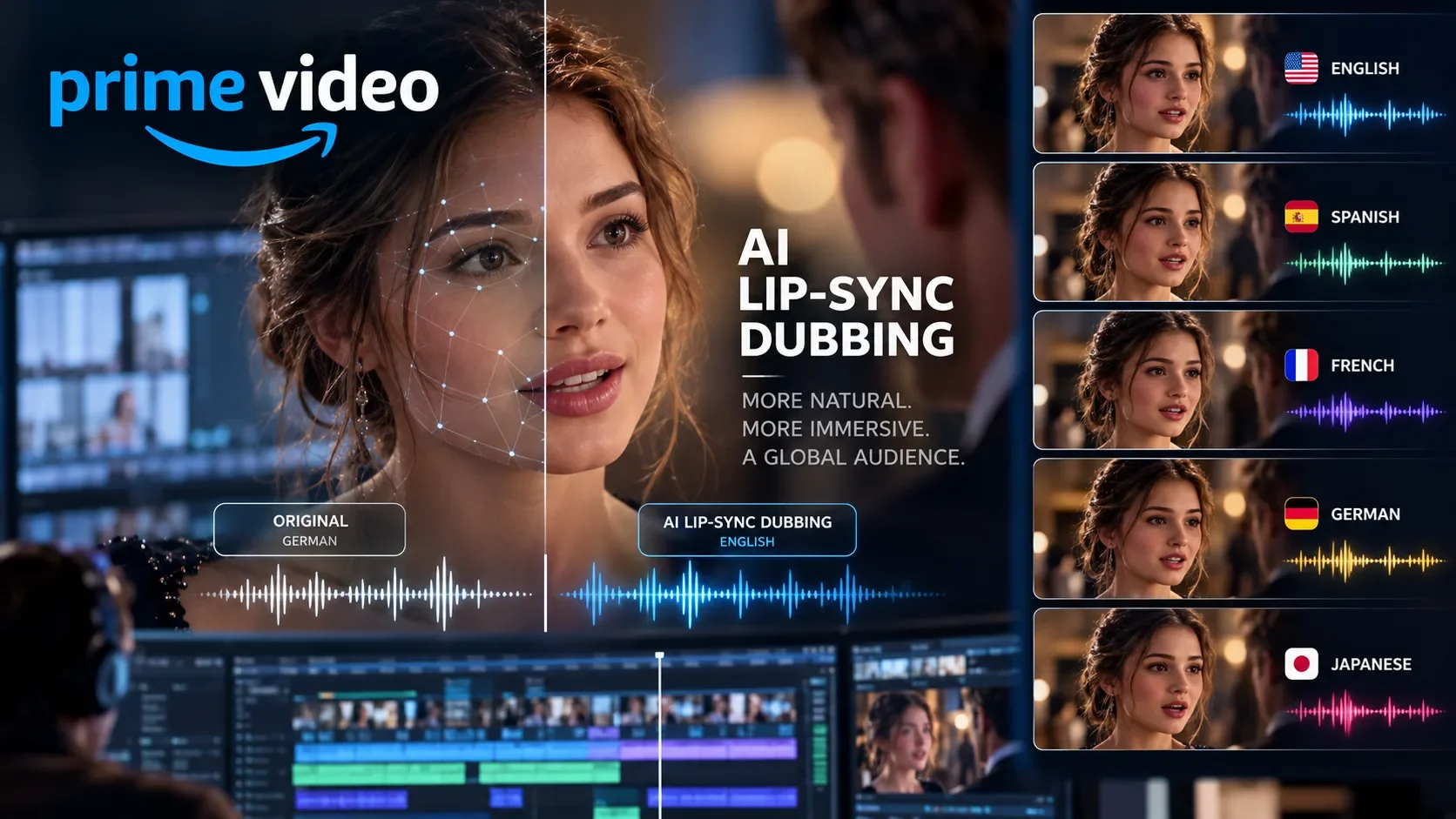
Launched in September 2026, the feature uses artificial intelligence and visual effects to synchronize actors' mouth movements with translated dialogue, creating a more natural viewing experience for international audiences.
For filmmakers, production companies, and streaming platforms, this development signals an important shift in how content can be localized and distributed worldwide.
What Is Amazon Prime Video's AI Lip-Sync Technology?
Traditional dubbing replaces a film or television show's original dialogue with voice recordings in another language. While professional dubbing can deliver excellent performances, the translated words rarely match the actors' original lip movements perfectly.
This mismatch can become distracting, particularly during close-up scenes or emotionally intense conversations.
Amazon's new technology addresses that problem by adjusting the actors' visible lip movements to correspond with the translated dialogue.
The process combines:
Artificial intelligence: Technology that helps adapt mouth movements to match translated speech.
Visual effects (VFX): Digital techniques that help integrate the adjustments into the original footage.
Human voice acting: Professional performers provide the translated dialogue.
Creative oversight: Human professionals help maintain the artistic integrity of the production.
Unlike fully AI-generated voice dubbing, this particular feature works with human-recorded dialogue.
The goal is not simply to translate a story but to make the translated performance feel more natural on screen.
Amazon Tests the Technology With Maxton Hall
Amazon introduced the technology through its popular German-language drama series Maxton Hall – The World Between Us.
The series became a major international success for Prime Video, making it a prominent choice for testing enhanced dubbing technology.
The AI lip-sync feature is currently available globally for the English-dubbed versions of Seasons 1 and 2.
Amazon has also confirmed that the technology will be included when the show's third and final season premieres on December 9, 2026.
Although the initial rollout is limited to one series and one dubbed language, Prime Video plans to expand the technology to additional titles.
This represents a significant step toward making international television more accessible without requiring viewers to rely entirely on subtitles.
Why AI Lip-Sync Dubbing Matters for Filmmakers
For decades, filmmakers distributing content internationally have faced a familiar challenge: how to preserve the emotional impact of performances when dialogue is translated.
Subtitles allow viewers to hear the original performances, but they require reading while watching.
Traditional dubbing removes the need for subtitles but can introduce noticeable differences between spoken dialogue and visible mouth movements.
AI-assisted lip synchronization offers another option.
1. More Immersive International Viewing
When dialogue and mouth movements appear synchronized, viewers may find it easier to focus on the story rather than the translation.
This could be particularly valuable for dramatic films, romantic scenes, and dialogue-heavy productions where facial expressions are central to the performance.
2. Greater Opportunities for Global Distribution
International distribution has become increasingly important as streaming platforms bring films and television programs to audiences worldwide.
Improved dubbing could make foreign-language content more appealing to viewers who prefer watching in their native language.
For independent filmmakers, the long-term potential is particularly interesting.
If this technology eventually becomes affordable and widely accessible, smaller productions could have more opportunities to reach international audiences.
3. New Possibilities in Post-Production
AI lip-sync technology adds another capability to the evolving world of digital post-production.
Editors and visual effects professionals are already using AI-assisted tools for tasks such as object removal, image enhancement, rotoscoping, transcription, and audio cleanup.
Visual dubbing introduces the possibility of adapting performances for different languages while retaining much of the original cinematography and visual storytelling.
However, achieving convincing results still requires attention to lighting, facial expressions, continuity, and the authenticity of the performance.
4. Potentially More Efficient Localization Workflows
Traditional localization involves translators, dialogue adapters, voice actors, dubbing directors, sound engineers, and quality-control specialists.
AI-assisted lip synchronization could eventually streamline certain parts of that process.
But it is important to distinguish potential benefits from proven results. Amazon has not publicly established that its new visual dubbing feature consistently reduces localization costs or production time.
Its immediate purpose is to improve the viewing experience.
AI Is Already Transforming Video Production
Amazon is not alone in exploring AI-powered language technology.
Meta has introduced AI translation features for Facebook and Instagram videos, while YouTube has expanded automatic dubbing capabilities for creators.
These developments reflect a broader industry trend: using artificial intelligence to help video content travel across language barriers.
At the same time, AI is influencing other areas of filmmaking and commercial production.
Pre-production: AI tools can assist with concept development, storyboarding, script analysis, and production planning.
Production: Intelligent camera systems, virtual production environments, and automated workflows can help production teams operate more efficiently.
Post-production: AI-assisted editing, audio processing, visual effects, and content localization can support faster creative workflows.
Distribution: Automated transcription, subtitles, translation, and metadata generation can help content reach new audiences.
For production companies, the opportunity lies in combining these technologies with professional storytelling, cinematography, sound, and editing expertise.
Can AI Replace Traditional Dubbing and Voice Actors?
One of the biggest questions surrounding AI in entertainment is whether automation will eventually replace human performers.
Amazon's new lip-sync approach demonstrates a different possibility.
Instead of replacing human voice actors with synthetic speech, the system uses human-dubbed audio and applies AI to the visual performance.
This approach recognizes the importance of emotional expression, vocal delivery, and artistic interpretation.
However, it also raises important questions about performer consent and the digital modification of recorded performances.
Changing an actor's mouth movements—even for localization—means altering part of the original performance.
As AI-powered filmmaking technology evolves, production companies will need clear policies concerning performer permissions, creative control, transparency, and appropriate use of digital likenesses.
The strongest applications of AI may be those that enhance professional creative work rather than attempt to eliminate the people behind it.
What This Means for the Future of Film Production
Amazon's announcement illustrates how artificial intelligence is becoming part of the infrastructure of modern entertainment.
What begins as a specialized feature for one streaming series could eventually influence international film releases, documentaries, advertising, educational videos, and branded content.
Consider a company producing a promotional video intended for audiences in the United States, Europe, and Asia.
Traditionally, creating localized versions might require separate voice recordings, subtitles, or additional production work.
Future AI-assisted workflows could make it easier to produce multiple language versions while maintaining a consistent visual presentation.
For commercial filmmakers and video production companies, this opens interesting possibilities for global campaigns.
A single production could potentially support a wider range of audiences without requiring every scene to be filmed again.
The technology is still developing, but its potential applications extend far beyond streaming entertainment.
The Human Element Still Matters
Artificial intelligence can improve technical processes, but successful filmmaking depends on much more than technology.
Compelling stories require emotional understanding, strong performances, creative direction, and visual craftsmanship.
Even when AI handles certain post-production tasks, human professionals remain essential to evaluating whether the final result feels authentic.
A perfectly synchronized mouth movement cannot compensate for a poorly translated script, an unconvincing vocal performance, or weak storytelling.
The future of filmmaking is therefore likely to involve greater collaboration between human creativity and intelligent production tools.
Final Thoughts: A New Chapter in AI-Powered Entertainment
Amazon Prime Video's introduction of AI lip-sync dubbing marks another milestone in the growing relationship between artificial intelligence and entertainment production.
By combining AI, visual effects, and human voice performances, Amazon is exploring a more seamless way for international audiences to enjoy stories from around the world.
For filmmakers, content creators, and production companies, the development highlights an expanding range of opportunities in localization, post-production, and global distribution.
As these tools continue to evolve, the industry will need to balance technological progress with artistic integrity and respect for performers.
The future of filmmaking is not simply about what artificial intelligence can create. It is about how technology can help great stories connect with audiences everywhere.
Bringing Innovation Into Video Production
At The American Movie Company, we recognize the growing role of emerging technologies in modern filmmaking and video production.
From professional studio production and commercial filmmaking to virtual production and AI-assisted creative workflows, new tools continue to expand the possibilities of visual storytelling.
As artificial intelligence reshapes the entertainment industry, the combination of creative expertise and innovative technology will remain essential to producing compelling content.
Explore our production services at AmericanMovieCo.com.
Sources:
Double-click to edit...