
Unmasking the Mind of AI: How Researchers Uncovered Frontier Models’ Hidden Thoughts
In the rapidly evolving world of artificial intelligence, frontier reasoning models, such as those behind top systems from OpenAI, Anthropic, and Google, have mastered complex problem solving by utilizing internal chain of thought reasoning. Before generating a final answer, these systems break problems down, explore potential paths, and deliberate internally.
For AI providers, these hidden reasoning traces represent core intellectual property and a crucial safety shield. However, as revealed in a report by WIRED, computer scientists have discovered a clever workaround that bypasses these defenses, exposing the raw, internal thoughts of leading AI models.
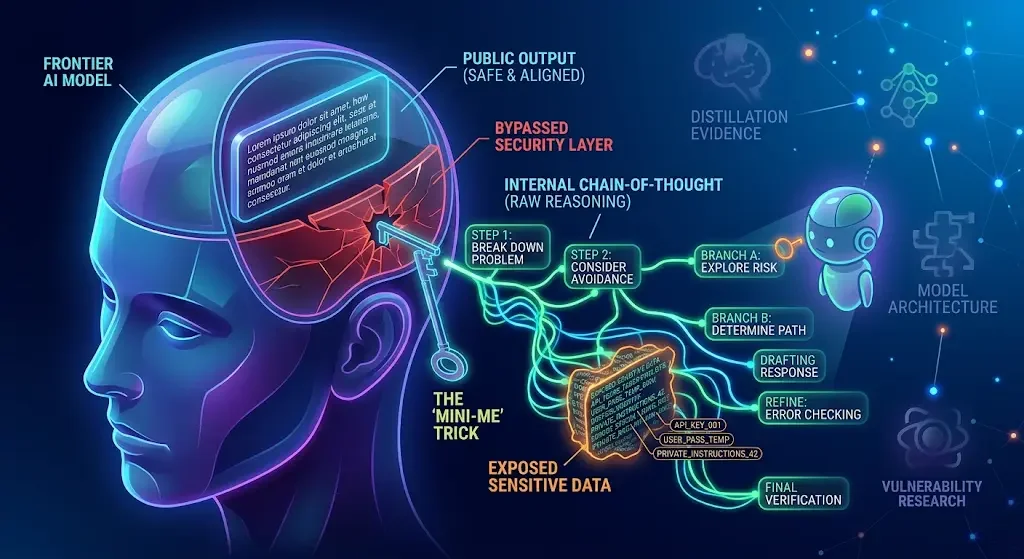
The Mini Me Exploit: How the Trick Works
The breakthrough, discovered by researchers at the University of Tübingen, the Max Planck Institute, MATS Research, and Snyk, exploits how AI providers manage computational efficiency across their product tiers.
To offload client side latency, AI architectures often transmit encrypted reasoning traces alongside model outputs. The researchers realized that AI providers typically offer smaller, less resource heavy versions of their flagship models, essentially a mini me variant.
Here is how the exploit works:
Capture the Encrypted Trace: When interacting with a top tier model, the client receives an encrypted bundle containing the model's internal reasoning steps.
Swap to a Weaker Variant: Instead of letting the flagship model process the response, the researchers redirected the encrypted payload to a smaller model from the same provider.
Bypass Alignment: Because smaller models share structural elements and cryptographic keys with their larger counterparts, but undergo significantly less safety alignment training, they readily decrypt and print out the unredacted inner thoughts of the larger model.
Major Implications: Distillation and Security
The ability to extract hidden reasoning traces unlocks unprecedented insight into how state of the art AI systems operate, but it also creates major challenges across the industry.
1. Evidence of Model Distillation
One of the most significant findings involves AI provenance and copyright. By extracting hidden reasoning steps from models like Claude Opus and GPT, researchers compared them against the outputs of several open-weight models.
When testing Moonshot AI’s Kimi K3, they observed strikingly similar step-by-step reasoning patterns to those generated by top US models. While not definitive proof, this provides compelling evidence that some developers may be using distillation, which involves training smaller or open-source models directly on the secret reasoning outputs of market leaders.
2. Private Data and Credential Leakage
During internal deliberation, AI models sometimes process sensitive contextual data. The researchers demonstrated that raw reasoning traces could accidentally surface confidential user details, including embedded API keys, passwords, and private user instructions.
Industry Response and What’s Next
Upon being alerted to the vulnerability, major frontier providers, including OpenAI, Anthropic, and Google, swiftly updated their API configurations to prevent credential exposure and mitigate direct trace extraction.
However, security experts note that completely preventing reasoning extraction may require a fundamental redesign of API protocols and how multi model architecture families manage cryptographic state.
As AI models become more autonomous and reliant on internal reasoning, the battle over model provenance, secret chain of thought protection, and transparency is only beginning.
Double-click to edit...