
Osmo vs GoPro
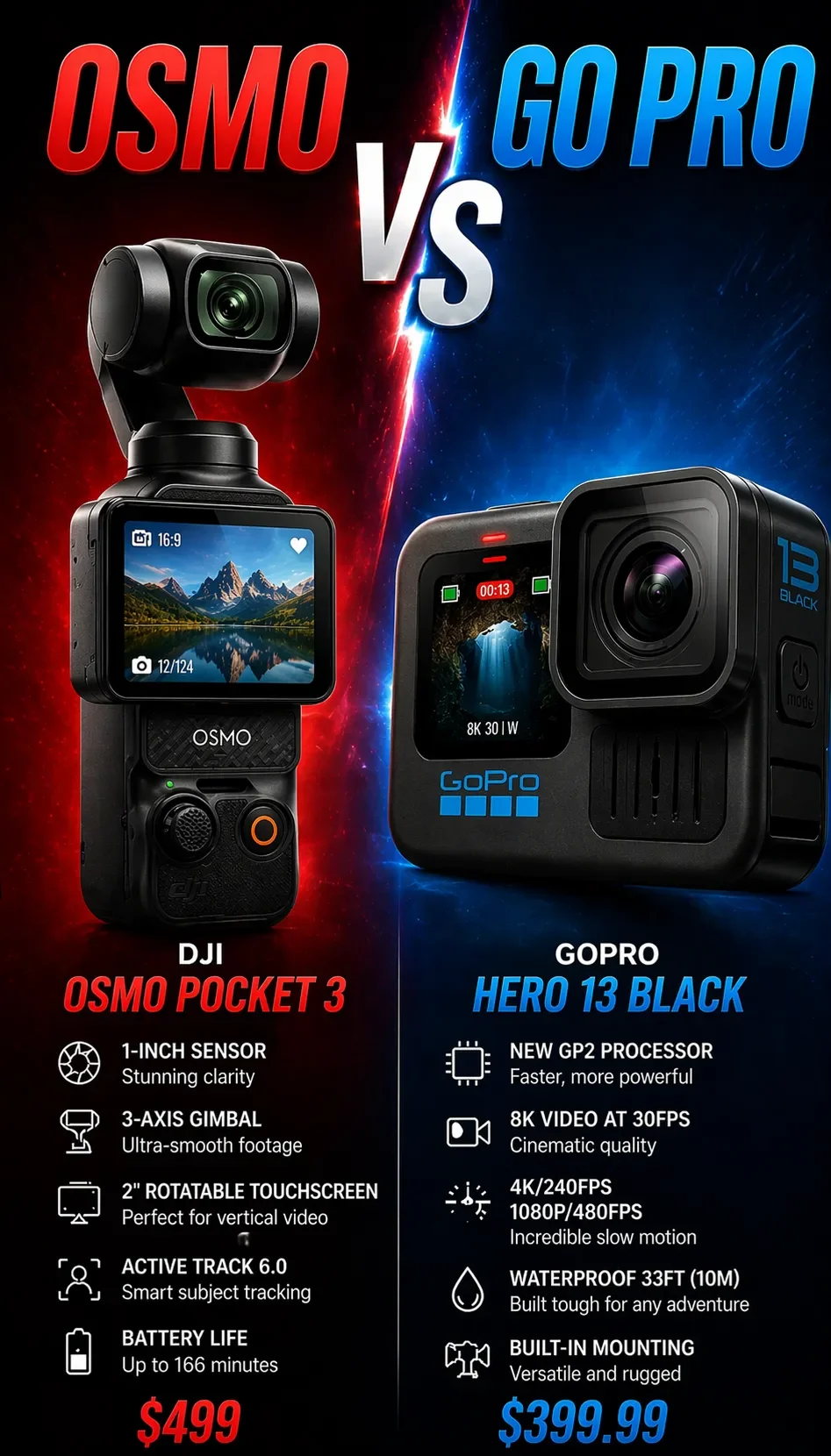
We just shot a documentary in Washington DC focusing on the plight of the thousands of Ukrainian children kidnapped by Russia.
It was a complicated shoot with some issues resolved using both the GoPro and Osmo cameras.
Here is our team’s analysis of the two
While GoPro created the action camera category, a large portion of today’s social video creators have shifted toward more compact and stabilized systems like the DJI Osmo Pocket 3, which has become something of a default tool for fast, high quality content creation.
The Osmo Pocket 3 succeeds because it solves several problems at once. It combines a one inch sensor with a built in three axis gimbal, delivering smooth, stabilized footage without the need for additional rigs.
The camera also features a rotating touchscreen, fast subject tracking, and strong low light performance, all in a device that fits easily in a pocket. For social media creators, especially those shooting vertical video, it is efficient, discreet, and extremely reliable.
By comparison, GoPro’s new Mission 1 is taking a different approach. Rather than focusing on stabilization through mechanics, it emphasizes raw imaging power. The larger sensor and upgraded processor allow for 8K recording at 30 frames per second, along with high frame rate options such as 4K at 240 frames per second and 1080 at 480 frames per second. This positions it closer to a compact cinema camera than a traditional action device. Where GoPro has historically excelled is durability and versatility. Its cameras are built for extreme environments, waterproof without additional housing, and easily mountable on helmets, vehicles, and rigs. The Mission 1 continues that tradition while significantly improving image quality, making it more appealing not just for action use but also for controlled production environments.
Our takeaway: The key difference between the two systems comes down to workflow. The Osmo Pocket 3 is designed for immediate usability. Turn it on, point, and shoot. The built in stabilization and tracking handle most of the technical work.
The GoPro Mission 1, while still compact, leans more toward users who want flexibility in post production, higher resolution, and more cinematic control. Another factor now entering the equation is regulation. The anticipated successor, the Osmo Pocket 4, has encountered obstacles in the United States due to regulatory approval issues. Federal Communications Commission approval is required for wireless devices, and without it, distribution becomes effectively blocked. This creates a temporary gap in the market that GoPro is well positioned to fill. This situation highlights a broader issue that many creators are only beginning to notice. Government regulations can directly influence which tools are available, even when those tools are already developed and widely used elsewhere. In this case, a popular upgrade cycle is interrupted, leaving existing models to carry the market longer than expected. From a buying perspective, this creates an unusual moment. The Osmo Pocket 3 remains one of the best all around tools for social video, particularly for stabilized, handheld shooting. The GoPro Mission 1, however, offers a significant leap in image capability and may appeal to creators looking for higher resolution, slow motion performance, and greater creative flexibility.
The decision ultimately comes down to use case. If the priority is speed, ease of use, and built in stabilization, the Osmo Pocket 3 remains difficult to beat. If the goal is pushing image quality, capturing extreme motion, or integrating into more advanced production workflows, the Mission 1 represents a compelling evolution of the action camera category. What is clear is that the gap between consumer and professional tools continues to narrow. At the same time, external factors like regulation are beginning to play a larger role in shaping what creators can actually access.GoPro still has ground to recover. While it created the action camera category, a large portion of today’s social video creators have shifted toward more compact and stabilized systems like the DJI Osmo Pocket 3, which has become something of a default tool for fast, high quality content creation.
The Osmo Pocket 3 succeeds because it solves several problems at once. It combines a one inch sensor with a built in three axis gimbal, delivering smooth, stabilized footage without the need for additional rigs. The camera also features a rotating touchscreen, fast subject tracking, and strong low light performance, all in a device that fits easily in a pocket. For social media creators, especially those shooting vertical video, it is efficient, discreet, and extremely reliable.
By comparison, GoPro’s new Mission 1 is taking a different approach. Rather than focusing on stabilization through mechanics, it emphasizes raw imaging power. The larger sensor and upgraded processor allow for 8K recording at 30 frames per second, along with high frame rate options such as 4K at 240 frames per second and 1080 at 480 frames per second. This positions it closer to a compact cinema camera than a traditional action device. Where GoPro has historically excelled is durability and versatility. Its cameras are built for extreme environments, waterproof without additional housing, and easily mountable on helmets, vehicles, and rigs. The Mission 1 continues that tradition while significantly improving image quality, making it more appealing not just for action use but also for controlled production environments. The key difference between the two systems comes down to workflow. The Osmo Pocket 3 is designed for immediate usability. Turn it on, point, and shoot. The built in stabilization and tracking handle most of the technical work. The GoPro Mission 1, while still compact, leans more toward users who want flexibility in post production, higher resolution, and more cinematic control. Another factor now entering the equation is regulation. The anticipated successor, the Osmo Pocket 4, has encountered obstacles in the United States due to regulatory approval issues. Federal Communications Commission approval is required for wireless devices, and without it, distribution becomes effectively blocked. This creates a temporary gap in the market that GoPro is well positioned to fill. This situation highlights a broader issue that many creators are only beginning to notice. Government regulations can directly influence which tools are available, even when those tools are already developed and widely used elsewhere. In this case, a popular upgrade cycle is interrupted, leaving existing models to carry the market longer than expected. From a buying perspective, this creates an unusual moment.
The Osmo Pocket 3 remains one of the best all around tools for social video, particularly for stabilized, handheld shooting. The GoPro Mission 1, however, offers a significant leap in image capability and may appeal to creators looking for higher resolution, slow motion performance, and greater creative flexibility. The decision ultimately comes down to use case. If the priority is speed, ease of use, and built in stabilization, the Osmo Pocket 3 remains difficult to beat. If the goal is pushing image quality, capturing extreme motion, or integrating into more advanced production workflows, the Mission 1 represents a compelling evolution of the action camera category. What is clear is that the gap between consumer and professional tools continues to narrow. At the same time, external factGoPro still has ground to recover. While it created the action camera category, a large portion of today’s social video creators have shifted toward more compact and stabilized systems like the DJI Osmo Pocket 3, which has become something of a default tool for fast, high quality content creation. The Osmo Pocket 3 succeeds because it solves several problems at once. It combines a one inch sensor with a built in three axis gimbal, delivering smooth, stabilized footage without the need for additional rigs. The camera also features a rotating touchscreen, fast subject tracking, and strong low light performance, all in a device that fits easily in a pocket. For social media creators, especially those shooting vertical video, it is efficient, discreet, and extremely reliable. By comparison, GoPro’s new Mission 1 is taking a different approach. Rather than focusing on stabilization through mechanics, it emphasizes raw imaging power. The larger sensor and upgraded processor allow for 8K recording at 30 frames per second, along with high frame rate options such as 4K at 240 frames per second and 1080 at 480 frames per second. This positions it closer to a compact cinema camera than a traditional action device. Where GoPro has historically excelled is durability and versatility. Its cameras are built for extreme environments, waterproof without additional housing, and easily mountable on helmets, vehicles, and rigs. The Mission 1 continues that tradition while significantly improving image quality, making it more appealing not just for action use but also for controlled production environments. The key difference between the two systems comes down to workflow. The Osmo Pocket 3 is designed for immediate usability. Turn it on, point, and shoot. The built in stabilization and tracking handle most of the technical work. The GoPro Mission 1, while still compact, leans more toward users who want flexibility in post production, higher resolution, and more cinematic control.