
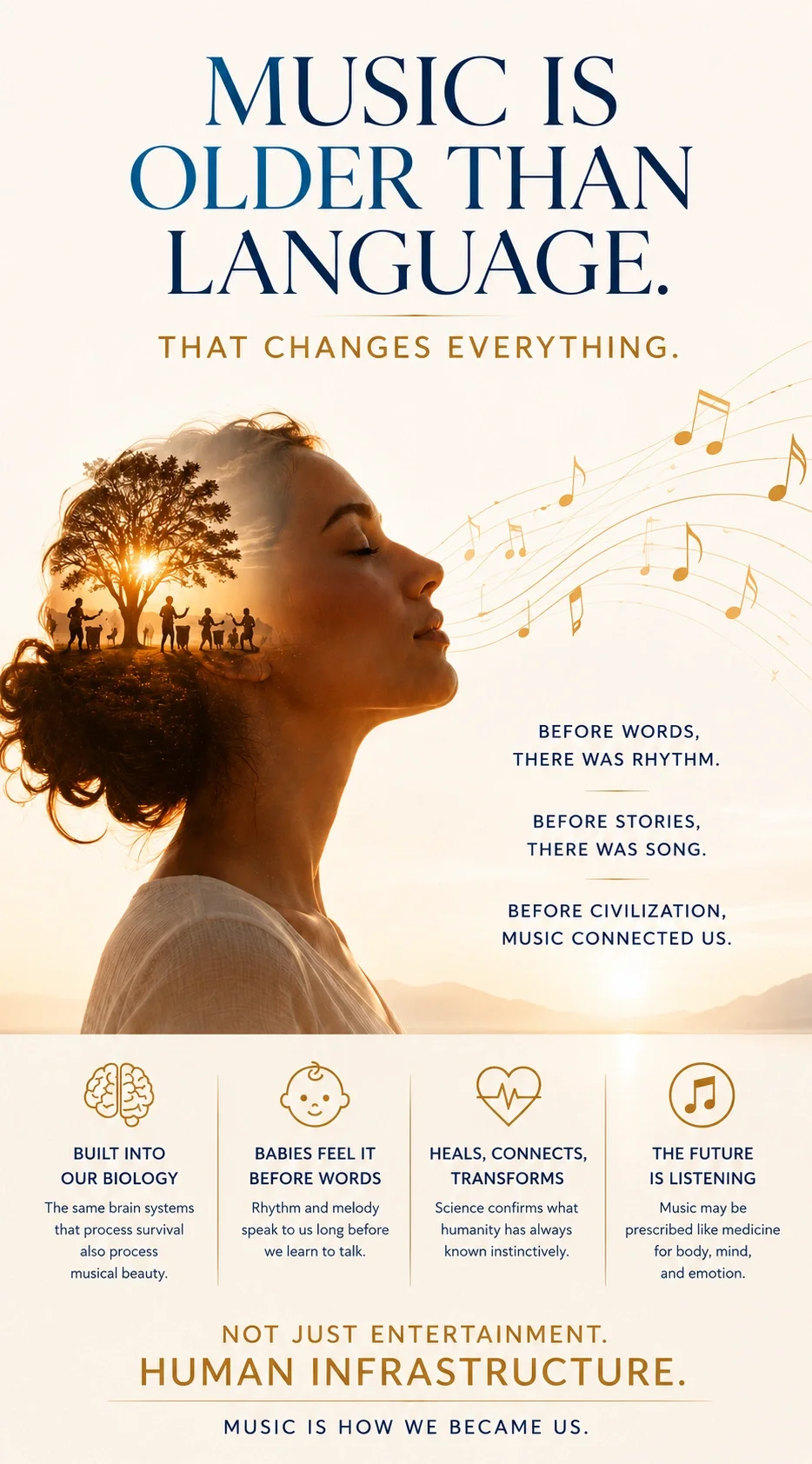
Music May Be Older Than Language. That Changes Everything.
By: Bill Milling
Here’s a thought that should stop every filmmaker, composer, editor, and producer dead in their tracks:
Music may be more than a million years older than language.
Not older than written language. Older than spoken language itself.
Professor Michael Spitzer argues that music is not simply entertainment or cultural decoration. It may actually be a biological system deeply embedded in human evolution long before humans had organized speech.
And honestly, the more you think about it, the harder it becomes to dismiss.
Because music does something almost terrifyingly powerful.
A chord progression can make you cry even if you have never heard it before. A rhythm can make your body move involuntarily. A piece of music can create dread, hope, grief, triumph, romance, or fear faster than language ever could.
Why?
Because music appears to operate beneath language.
Your Brain Does Not Treat Music Like “Entertainment”
This is where things become fascinating for filmmakers and storytellers.
Neuroscientists have discovered that music activates some of the oldest and deepest regions of the human brain. Incredibly, some of the same neural systems involved in survival, threat detection, attachment, and emotional regulation are also involved in musical response.
Think about that for a moment.
The same biological machinery that once helped early humans detect danger in the wild now reacts to harmony, rhythm, tempo, and tonal shifts.
That may explain why a low cello note in a thriller creates tension instantly before the audience consciously understands why.
Or why a choir can create feelings of transcendence in a film with almost no dialogue.
Or why two piano notes can suddenly unlock a memory from 30 years ago.
Music bypasses explanation and goes directly into sensation.
Long before humans could say, “I am frightened,” they may already have been able to sing fear.
Babies Understand Rhythm Before Words
One of the most astonishing things researchers continue to observe is that babies respond to rhythm almost immediately.
Before language develops. Before vocabulary. Before logic.
Infants react to cadence, pitch, timing, pulse, and melodic contour.
In some ways, music may be humanity’s first emotional operating system.
A mother soothing a child with melody may actually be activating ancient evolutionary pathways that predate civilization itself.
Suddenly, lullabies stop seeming quaint.
They begin looking biological.
Filmmakers Have Always Known This Instinctively
Cinema understood this long before science caught up.
Take the music away from Jaws, and the shark becomes less frightening.
Remove the score from Star Wars, and the mythology weakens.
Imagine The Godfather without Nino Rota.
Or Interstellar without Hans Zimmer.
Or Psycho without Bernard Herrmann’s stabbing violins.
Music does not simply accompany an image.
It alters the viewer’s nervous system while the image unfolds.
That is not decoration.
That is neurobiology.
The Future May Treat Music Like Medicine
This is where the conversation becomes even more interesting.
Researchers are now exploring music as therapy for:
Conditions Being Studied
• Alzheimer’s disease
• PTSD
• Depression
• Parkinson’s disease
• Anxiety disorders
• Stroke rehabilitation
• Chronic pain
• Autism spectrum conditions
Early Findings
Some early findings are remarkable.
Patients who cannot remember family members can suddenly remember songs.
Parkinson’s patients sometimes regain movement synchronization through rhythm.
Music therapy is increasingly being studied not as “alternative medicine,” but as a neurological intervention.
In the future, doctors may prescribe carefully designed musical experiences the same way they prescribe pharmaceuticals today.
That sounds futuristic until you realize humans have probably used music as medicine for hundreds of thousands of years.
We just called it a ceremony, ritual, storytelling, mourning, celebration, prayer, dance, or war.
AI Music Changes the Equation Again
Now we enter strange territory.
Artificial intelligence can already generate convincing music in seconds.
Some of it is surprisingly emotional.
The Emerging Question
If music is deeply biological, can machines eventually learn to manipulate human emotional systems with extreme precision?
Probably yes.
And filmmakers, advertisers, political strategists, game designers, and social media companies are all paying attention.
What Comes Next
The next generation of media may not simply contain music.
It may dynamically generate music engineered in real time to influence human emotion minute by minute.
That possibility is both exciting and slightly terrifying.
Music Is Not Just Art. It May Be Human Infrastructure.
Based on an article by Big Think and Michael Spitzer
Maybe we have misunderstood music all along.
Maybe music is not an accessory to civilization.
Maybe it helped build civilization.
Before Language, There Was Rhythm
Before humans organized words into grammar, they may have already organized emotion into rhythm.
Before speeches, there were chants.
Before politics, there were drums.
Before philosophy, there were songs.
And somewhere in the distant past, long before cameras, scripts, streaming platforms, or AI video generators existed, a human being struck a rhythm against stone or wood, and another human understood the feeling instantly.
No translation required.