
Google Books Are Coming. Apparently, Your Laptop Now Wants To “Help.”
By: Bill Milling
Well, here we go again.
Just when everybody finally figured out what a Chromebook actually was, Google has apparently decided to reinvent the laptop again.
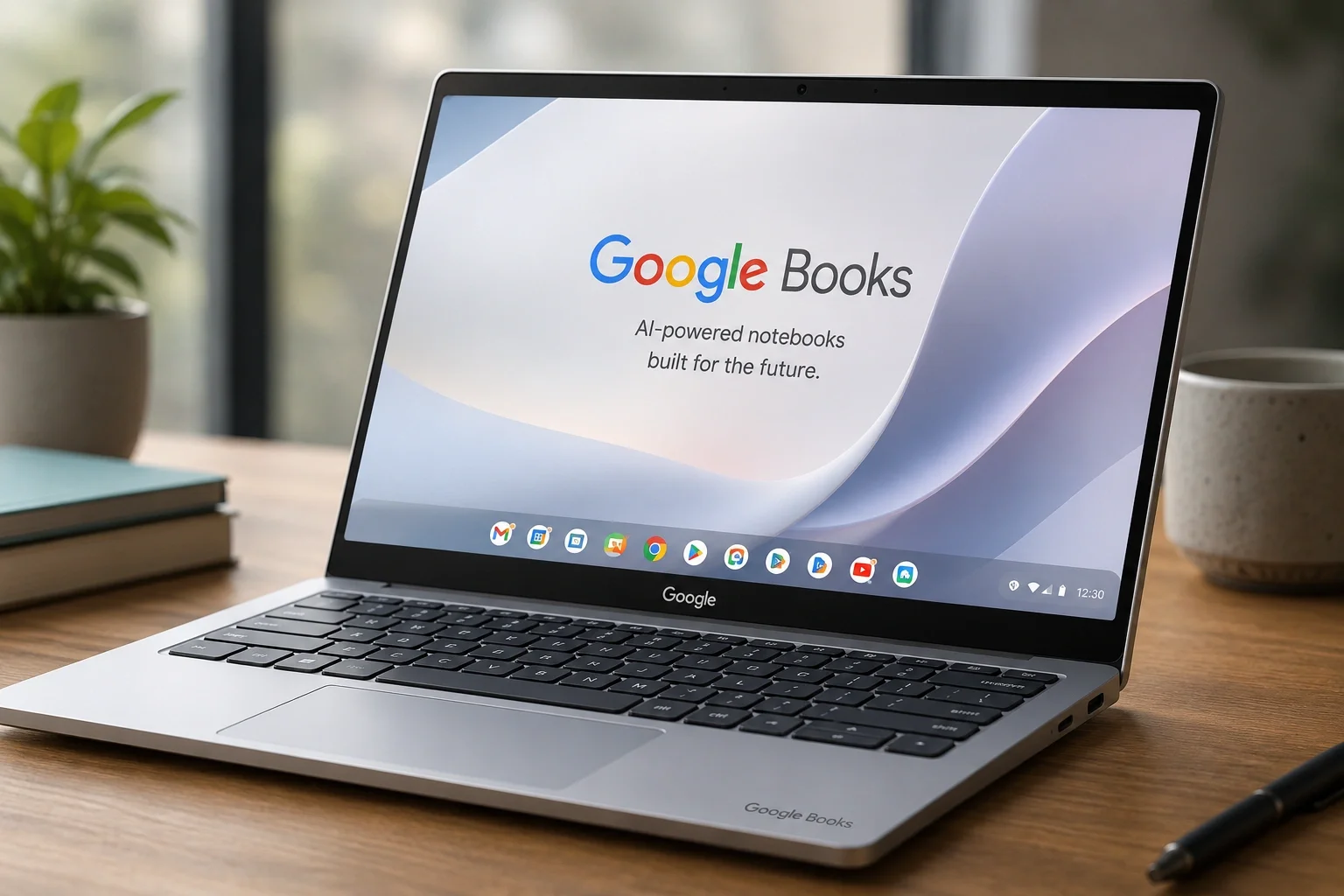
This fall, we are about to meet something called the “Google Book.”
And no, before you ask, it is not a Chromebook.
Because in the technology business, apparently the first rule is:
Never name anything clearly if confusion is still possible.
What makes this especially interesting is that these new machines are reportedly not based on ChromeOS at all. They are built around Android technologies instead.
Translation:
Your phone and your laptop are now slowly merging into one AI-powered organism.
Somewhere, a desktop computer just began sweating nervously.
The Big Idea: AI Everywhere
Google is positioning these machines as deeply AI-integrated devices built around Gemini.
And honestly, the direction is pretty obvious now.
The future operating system is no longer Windows, macOS, Android, or ChromeOS.
The future operating system is AI itself.
The actual computer increasingly matters less than the intelligence layer sitting on top of it.
That is the real story here.
Enter the “Magic Pointer”
This may be my favorite part.
Google Books reportedly features something called a “Magic Pointer.”
Which sounds either incredibly futuristic or like something sold on QVC at 2:15 in the morning.
Apparently, you can wiggle your cursor over almost anything and Gemini jumps in with contextual suggestions.
Hover over a date in an email?
Gemini suggests creating a calendar appointment.
Hover over an address?
Directions.
Hover over a product?
Shopping suggestions.
Hover over your overdue taxes?
Possibly witness protection.
At this point, your cursor is basically becoming a junior executive producer.
The End of “Applications” As We Know Them
This is where things get philosophically interesting.
Google says many apps will essentially become desktop versions of Android apps.
That sounds subtle, but it is actually massive.
For decades, computers were built around standalone software:
• Photoshop
• Word
• Excel
• Premiere
• Avid
• Final Cut
Now software increasingly behaves more like cloud-connected services with AI floating through everything constantly.
The distinction between:
• app
• assistant
• operating system
• search engine
• workflow tool
...is starting to disappear completely.
And honestly, for video production people, this could become extremely important.
Why Producers Should Pay Attention
If Google executes this correctly, these machines could become surprisingly useful for producers, editors, coordinators, and media companies.
Imagine:
• automatically summarizing emails
• instantly generating call sheets
• AI organizing footage
• automatic transcription
• multilingual translation
• instant meeting summaries
• contextual research while editing
• AI-generated presentation decks
• live scheduling assistance
In other words:
Your laptop stops being passive hardware and starts acting like an assistant producer.
Possibly an assistant producer who never sleeps and does not steal bottled water from craft services.
But There’s Also a Weird Side to This
Every tech company now wants your computer to “understand context.”
That sounds helpful until your laptop starts becoming emotionally involved in your decisions.
Imagine:
“Bill, I noticed you’ve opened 47 tabs related to camera gear again. Financially, this feels unwise.”
Or:
“You appear stressed. Would you like calming music, meditation, or a lower credit limit?”
We joke now.
But honestly, this is exactly where computing is heading.
The interface is disappearing.
The AI becomes the experience itself.
The Real Battle Is Ecosystems
This is not really about laptops.
It is about ecosystems.
Apple wants every device connected.
Microsoft wants AI embedded in everything.
Google wants Android and Gemini everywhere.
OpenAI wants AI to become the new operating layer for human productivity itself.
Everybody is racing toward the same destination:
Computers that proactively assist instead of waiting for commands.
The machine is no longer just responding.
It is participating.
That changes everything.
My Prediction
Within five years, most people will stop “using software” the way we think about it today.
Instead, they will simply describe what they want:
“Create a sizzle reel.”
“Build a budget.”
“Schedule interviews.”
“Color correct this.”
“Translate this into Portuguese.”
“Create social clips.”
“Generate a pitch deck.”
And AI systems across multiple devices will quietly coordinate the process in the background.
The operating system becomes invisible.
Intent becomes the interface.
Which is both incredibly exciting and just slightly terrifying.
Especially for those of us who still occasionally yell at printers.