
AI and the Future of Filmmaking
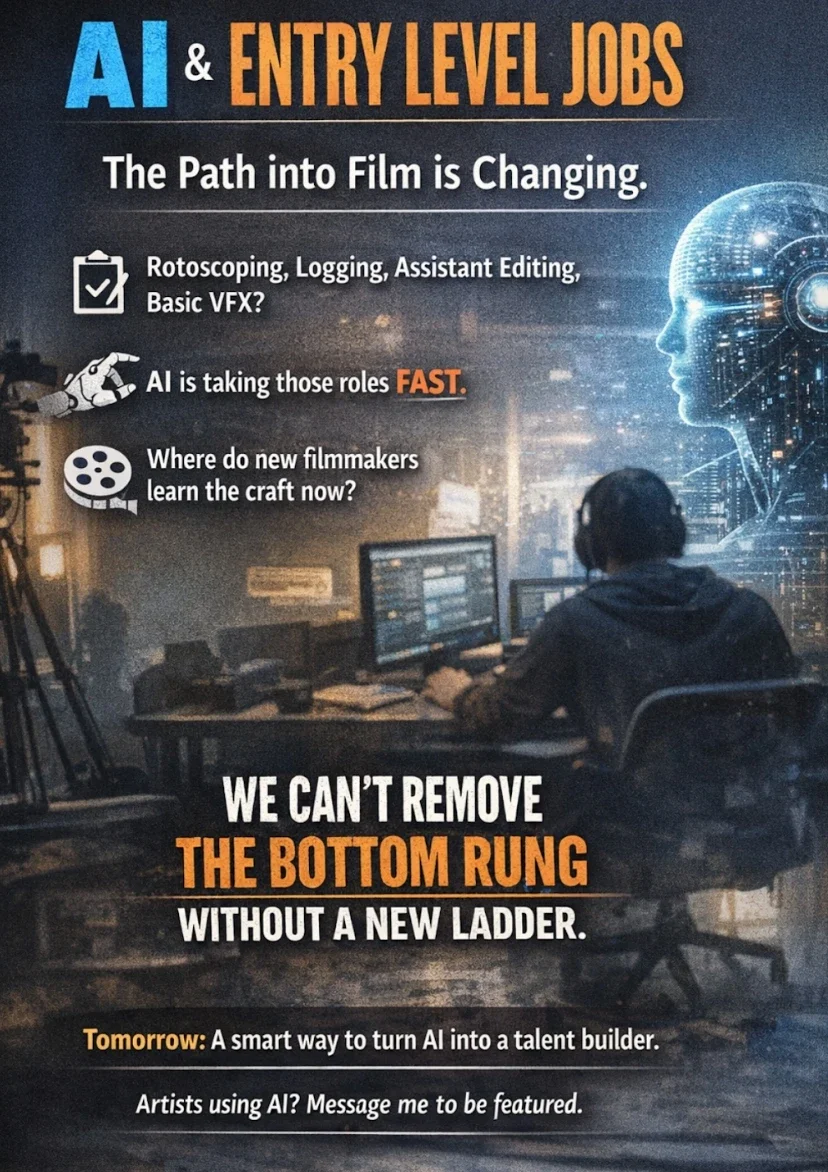
The quiet truth about AI in film production is this: the way people get started is changing faster than anything else.
Entry-level jobs are shifting or disappearing, and they’re the same roles many of us built our careers on. Rotoscoping, logging, assistant editing, transcription, basic VFX cleanup, rough previs, temp music, even early script breakdowns—these weren’t just boxes to tick or hours to bill. They were training grounds, the places where you quietly absorbed rhythm, pacing, coverage, continuity, and, eventually, taste.
Today, AI systems can handle many of these tasks faster and cheaper. That’s no longer a hypothetical future; it’s day-to-day reality in more and more productions. The debate about whether AI will replace entry-level jobs is already behind us. In many corners of the industry, it’s happening.
So the real question isn’t “Will AI take these roles?” The real question is: what replaces the on-ramp?
Because those “grunt work” jobs did something crucial: they gave people a way in. They let you sit in the room, scrub through footage, organize chaos, and slowly understand why one frame mattered and another didn’t. They created space for late-night questions, side-by-side problem solving, and the kind of informal mentorship that can’t be scheduled into a one-hour Zoom.
If we pull out that bottom rung without building a new one, we risk creating a film industry where opportunity narrows instead of widens. An industry where only the already-connected, already-resourced, or already-trained get to participate. The next generation will not learn the craft by watching timelines fill themselves, shots auto-clean, or dialogue auto-transcribe. Automation can handle tasks, but it cannot replace the slow, messy, human process of learning judgment.
This is where real leadership comes in.
Studios, producers, and vendors who think ahead won’t just plug AI into their pipelines and call it innovation. They’ll ask:
How do we redesign apprenticeship when “busy work” disappears?
How do we make room for junior creatives to shadow, experiment, and fail safely?
How do we give newcomers ownership over decisions, not just supervision over machines?
That may mean creating intentional assistant and trainee programs where the “work” isn’t just manual tasks, but guided creative reps. It may mean pairing AI tools with structured feedback: not just “let the model rotoscope,” but “have a junior artist review, correct, and discuss why those corrections matter.” It may mean budget lines explicitly dedicated to learning, not just output.
AI will not kill filmmaking. Stories will still be written, images will still be framed, performances will still move us. But AI will absolutely reshape how filmmakers are made.
If we’re careless, we’ll end up with faster workflows and fewer pathways in. If we’re deliberate, we can build a future where AI handles more of the drudgery, and humans focus more on the craft—without losing the ladder that gets people there.
The technology is here. The question now is whether we treat it as a shortcut, or as a chance to redesign how we grow the next generation of filmmakers.
Double-click to edit...